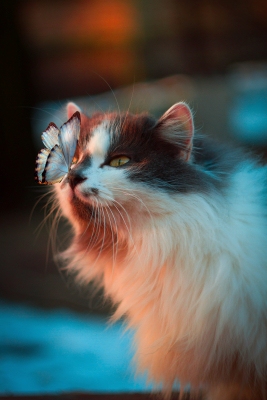
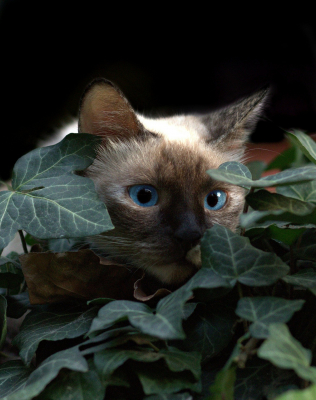
Kittens, as well as a number of other animal offspring, are born blind. Their eyes open around the tenth day of their life and only after another week, they are fully functional. Even though the sight in a cat belongs among the best-developed senses, cats are slightly short-sighted for their whole lives.
Kittens, as well as a number of other animal offspring, are born blind. Their eyes open around the tenth day of their life and only after another week, they are fully functional. Even though the sight in a cat belongs among the best-developed senses, cats are slightly short-sighted for their whole lives.
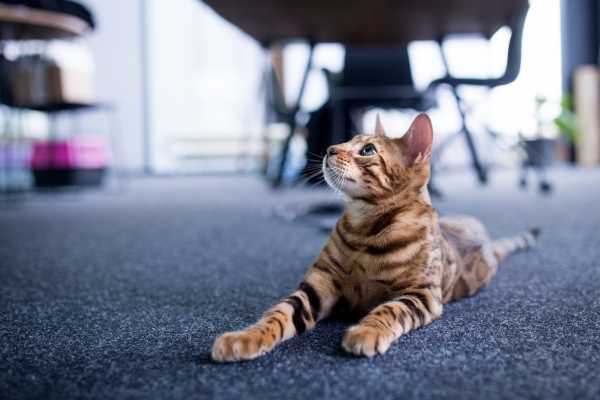
Cat’s sight has the greatest sharpness when observing at a distance of two to six meters. But what happens right in front of its nose, the cat recognises rather through smell or using its whiskers, same as in the first days after the birth, when it’s directly dependent on these senses. What causes that?
Cat has limited eye mobility to the sides comparing to humans and also a smaller field of view. While we have about 220 degrees, cats have 205 degrees. However, it can better focus even on the edges of the field of view, because its eye lens is more bent. It also compensates it by a greater degree of spatial vision, which is for it, as for a hunter of small rodents in uneasy terrain, a great advantage.
Cats can also see really well in the dark. How come? Their cornea is more convex, so it captures more light beams. The pupil dilates depending on the amount of light. The less there is, the larger the pupil gets. It can cover almost the entire iris and thereby it lets maximum amount of light in the eye. This again corresponds with the life rhythm of the cat. Since it often hunts at twilight or in the dark. Under direct light, we can hardly see the pupil. It pulls back into a thin strip to protect the sensitive retina.
This brings us to another difference. While people have their pupil round under every light, the cat’s pupil pulls back into an elliptical shape, a thin strip. This happens, because it is closed by two muscles from the sides.
Cat’s eye is unique since a cat, as the only animal, has one extra vascular layer behind the retina - the so-called tapetum lucidum. It is composed of layers of reflective cells, a kind of “mirror”. The beams that once pass through the retina, reflect from it on the second reflective layer and they stimulate the receptors again. You could say, that every beam of light is used twice. That’s why cats need only a minimum amount of light for seeing. This reflective layer is also responsible for the effect of shining cat eyes.
When it comes to the colour seeing of cats, we still don’t understand it completely. However, it is deemed, that cats don’t put too much weight on colours. For example, rather than by colour, the kittens choose toys depending on whether they’re moving, making a sound or because of higher temperature. So far, we’ve only found that cat eyes contain cones that react to blue, green and yellow colour, while cones for red are missing completely.
From humans, the cat differs by the fact, that its eye has also a third eyelid, a winking membrane. It is only a thin membrane that constantly moistens and cleans the eye. That’s why cats almost don’t have to blink. This applies to cats around the whole world. What distinguishes the fluffy guys between them is the shape of the eye and their colour. Particularly the eye colour, next to slight deviations from head anatomy, is one of the important characteristics of the individual breeds.
Whether you’re rearing a cat anywhere, the cat’s eyes are an incredible organ without any doubt, which surpasses human eyesight in many respects :).
Pokud hledáte společenské plemeno jako vyšité, už ho máte. Japonský chin totiž bere roli společníka jako své životní poslání. Tenhle minipsík je veselý, hravý a poslušný parťák pro děti i dospělé.
Chcete psovi dopřát to nejlepší, ale na trhu je tolik značek a druhů konzerv, že vám z toho jde hlava kolem? Přináším vám pár tipů, podle čeho vybírat, co by v konzervě chybět nemělo a co by se tam naopak nemělo vůbec ukázat.
Vztahy mezi kočkou a psem bývají všelijaké. Někteří jsou parťáci na život a na smrt, jiní úhlavní nepřátelé. Tady je příběh naší smečky, kterou si prošly všelijaké charaktery, ale vždy jsme se nějak sžili.
V létě ze sebe odhazujeme jeden svršek za druhým. Zvlášť pak v posledních letech, kdy i u nás teploty šplhají až do tropických hodnot. Možná si říkáte, že huňatý kožich vašeho mazlíka mu musí působit peklo a bude lepší ho ostříhat. Je tomu opravdu...
Na kočku venku čeká spoustu dobrodružství a snad i pár kočičích kamarádů, stejně tak tam ale na ni číhá spousta různých nebezpečí. Co všechno může kočku venku potkat?
Nejen psi a kočky s námi neverbálně komunikují. I králíci nám svými neverbálními projevy, jako jsou postoje, gesta a zvuky, dávají najevo, co cítí a jak jim je. To nám pomáhá porozumět, v jakém rozmaru se právě nacházejí. Pojďme se podívat na projevy...
https://krmivo-brit.cz/cs/
I psům dnes můžete pořídit přírodní varianty antiparazitik, nebo jim je vyrobit doma. V čem jsou jejich přednosti a nedostatky?
Jak je známo, kočky milují světlo a teplo, rády polehávají na rozehřátých parapetech. Proto i když jsou proslulými spáči, s příchodem jara se v nich probouzí energie, jsou aktivnější, společenštější a veselejší. A co především, probouzí se v nich...
FIV je obávaným virovým onemocněním koček. Způsobuje pomalý rozvrat imunitního systému, podobně jako lidský virus HIV. Jaká je příčina a průběh této zákeřné nemoci a jak vypadá její konečné stádium?
Jídlo, stejně jako pro člověka, je i pro psy jednou z nejzákladnějších potřeb. Jak zajistit, aby se pejskovi dostalo všech potřebných živin? A pokud se rozhodnu pro granule, jaká krmiva jsou na výběr? A podle čeho mezi nimi vybírat?
Většina z nás řeší složení obsahu pytlů s granulemi, ale zamysleli jste se někdy nad obaly samotnými? Víte, do čeho se granule balí, jak se od sebe jednotlivé materiály liší a jaké vychytávky můžete na pytlích od granulí najít?
Barmu poznáte hlavně podle její hedvábné srsti s krásným, hlubokým leskem a typickými znaky barvy, které se u žádného jiného plemene nevyskytují. Kromě lesklého kožíšku se toto plemeno vyznačuje i skvělým charakterem, který z těchto koček dělá bezvadné...