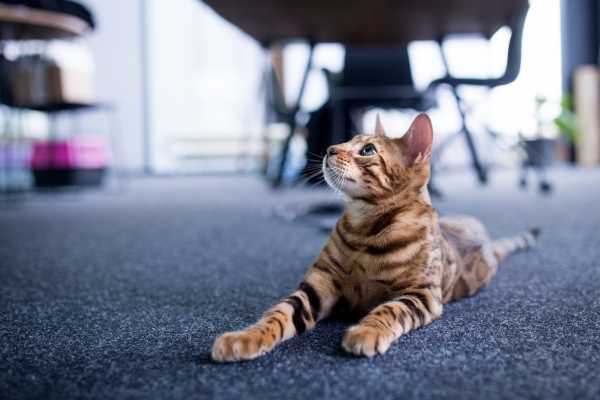
Kittens, as well as a number of other animal offspring, are born blind. Their eyes open around the tenth day of their life and only after another week, they are fully functional. Even though the sight in a cat belongs among the best-developed senses, cats are slightly short-sighted for their whole lives.
Kittens, as well as a number of other animal offspring, are born blind. Their eyes open around the tenth day of their life and only after another week, they are fully functional. Even though the sight in a cat belongs among the best-developed senses, cats are slightly short-sighted for their whole lives.
Cat’s sight has the greatest sharpness when observing at a distance of two to six meters. But what happens right in front of its nose, the cat recognises rather through smell or using its whiskers, same as in the first days after the birth, when it’s directly dependent on these senses. What causes that?
Cat has limited eye mobility to the sides comparing to humans and also a smaller field of view. While we have about 220 degrees, cats have 205 degrees. However, it can better focus even on the edges of the field of view, because its eye lens is more bent. It also compensates it by a greater degree of spatial vision, which is for it, as for a hunter of small rodents in uneasy terrain, a great advantage.
Cats can also see really well in the dark. How come? Their cornea is more convex, so it captures more light beams. The pupil dilates depending on the amount of light. The less there is, the larger the pupil gets. It can cover almost the entire iris and thereby it lets maximum amount of light in the eye. This again corresponds with the life rhythm of the cat. Since it often hunts at twilight or in the dark. Under direct light, we can hardly see the pupil. It pulls back into a thin strip to protect the sensitive retina.
This brings us to another difference. While people have their pupil round under every light, the cat’s pupil pulls back into an elliptical shape, a thin strip. This happens, because it is closed by two muscles from the sides.
Cat’s eye is unique since a cat, as the only animal, has one extra vascular layer behind the retina - the so-called tapetum lucidum. It is composed of layers of reflective cells, a kind of “mirror”. The beams that once pass through the retina, reflect from it on the second reflective layer and they stimulate the receptors again. You could say, that every beam of light is used twice. That’s why cats need only a minimum amount of light for seeing. This reflective layer is also responsible for the effect of shining cat eyes.
When it comes to the colour seeing of cats, we still don’t understand it completely. However, it is deemed, that cats don’t put too much weight on colours. For example, rather than by colour, the kittens choose toys depending on whether they’re moving, making a sound or because of higher temperature. So far, we’ve only found that cat eyes contain cones that react to blue, green and yellow colour, while cones for red are missing completely.
From humans, the cat differs by the fact, that its eye has also a third eyelid, a winking membrane. It is only a thin membrane that constantly moistens and cleans the eye. That’s why cats almost don’t have to blink. This applies to cats around the whole world. What distinguishes the fluffy guys between them is the shape of the eye and their colour. Particularly the eye colour, next to slight deviations from head anatomy, is one of the important characteristics of the individual breeds.
Whether you’re rearing a cat anywhere, the cat’s eyes are an incredible organ without any doubt, which surpasses human eyesight in many respects :).
Britský designér a vynálezce Dominic Wilcox otevřel v Londýně svou novou výstavu s názvem Play More. Dokazuje, že umění není určeno jen pro lidi. Jedná se totiž o první výstavu určenou výhradně pro psy. Najdete tu obrazy, bazén s kuličkami nebo...
Klonování patří k výdobytkům moderní doby. Leckoho tedy asi nepřekvapí, že svět má už nějaký ten rok i svého prvního naklonovaného psa. Pojmenovali ho Snuppy, což si jistě dobře zapamatujete kvůli podobnosti s pouze jinak psaným jménem Snoopy, jehož...
Nikomu bych nepřála se dostat do situace, kdy by veterinární záchrannou službu potřeboval. Stát se ale může cokoli a je lepší být na takové případy připraven. Koneckonců, může to znamenat rozdíl mezi životem a smrtí vašeho mazlíka.
Možná i vy máte doma malého čtyřnohého stresaře. V takovém případě čtěte pozorně, třeba tu narazíte na něco, co jste ještě ve snaze zbavit parťáka stresu nezkoušeli.
Pravděpodobně jste se setkali s názorem, že mnohem důležitější než to, co psovi říkáte, je, jakým způsobem (tónem) to říkáte. Ukazuje se ale, že psi lidské řeči mohou rozumět lépe, než jim obecně přisuzujeme.
Každý z nás určitě rád fotí svoje mazlíky. Ne vždy ale fotky vyjdou podle očekávání. Tady je proto pár rad, jak fotografování zvládnout, a co nejlépe zachytit ty naše chlupaté společníky.
Mohlo by se zdát, že čím menší zvíře, tím méně péče bude vyžadovat. Nenechte se však mýlit. I pokud máte doma myšku, křečka nebo třeba morče, měli byste péči o něj přizpůsobovat ročnímu období a situacím, jimž je vystavujete. V parných dnech, jaké nás...
Mnohokrát jsem zůstala při padacích manévrech své kočičí parťačky udiveně zírat s otevřenou pusou. Nedalo mi to a začala jsem hledat více informací o tom, kde se vzala kočičí šikovnost dopadnout vždycky na všechny čtyři a být… jak to říct… gumová.
Srí Lanka – dovolenkový ráj v jihovýchodní Asii, pro cestovatele země zaslíbená. Domluvit se anglicky tam není problém, ceny jsou vcelku nízké, domorodci jsou chudí, ale přátelští… Milovníkům psů se tam však naskýtá kromě pohádkových panoramat i smutný...
Domácí mazlíček přináší radost, to ví každý, kdo s nějakým žije v jedné domácnosti. Svojí hravostí a nepodmíněnou láskou nás často odpoutá od stresujících myšlenek a povinností. Učí nás žít tady a teď, soustředit se chvíli na přítomnost. Možná i to je...
V tomto cyklu se seznámíme se slavnými psími osobnostmi. Psi v našem životě hrají přeci důležitou roli, tak se pojďme podívat, co vše už za dobu našeho soužití dokázali. Bobbie ušel neuvěřitelných 4000 kilometrů, aby se vrátil ke své rodině.