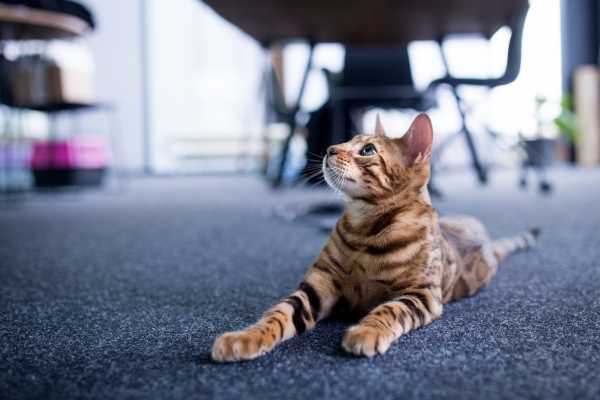
Kittens, as well as a number of other animal offspring, are born blind. Their eyes open around the tenth day of their life and only after another week, they are fully functional. Even though the sight in a cat belongs among the best-developed senses, cats are slightly short-sighted for their whole lives.
Kittens, as well as a number of other animal offspring, are born blind. Their eyes open around the tenth day of their life and only after another week, they are fully functional. Even though the sight in a cat belongs among the best-developed senses, cats are slightly short-sighted for their whole lives.
Cat’s sight has the greatest sharpness when observing at a distance of two to six meters. But what happens right in front of its nose, the cat recognises rather through smell or using its whiskers, same as in the first days after the birth, when it’s directly dependent on these senses. What causes that?
Cat has limited eye mobility to the sides comparing to humans and also a smaller field of view. While we have about 220 degrees, cats have 205 degrees. However, it can better focus even on the edges of the field of view, because its eye lens is more bent. It also compensates it by a greater degree of spatial vision, which is for it, as for a hunter of small rodents in uneasy terrain, a great advantage.
Cats can also see really well in the dark. How come? Their cornea is more convex, so it captures more light beams. The pupil dilates depending on the amount of light. The less there is, the larger the pupil gets. It can cover almost the entire iris and thereby it lets maximum amount of light in the eye. This again corresponds with the life rhythm of the cat. Since it often hunts at twilight or in the dark. Under direct light, we can hardly see the pupil. It pulls back into a thin strip to protect the sensitive retina.
This brings us to another difference. While people have their pupil round under every light, the cat’s pupil pulls back into an elliptical shape, a thin strip. This happens, because it is closed by two muscles from the sides.
Cat’s eye is unique since a cat, as the only animal, has one extra vascular layer behind the retina - the so-called tapetum lucidum. It is composed of layers of reflective cells, a kind of “mirror”. The beams that once pass through the retina, reflect from it on the second reflective layer and they stimulate the receptors again. You could say, that every beam of light is used twice. That’s why cats need only a minimum amount of light for seeing. This reflective layer is also responsible for the effect of shining cat eyes.
When it comes to the colour seeing of cats, we still don’t understand it completely. However, it is deemed, that cats don’t put too much weight on colours. For example, rather than by colour, the kittens choose toys depending on whether they’re moving, making a sound or because of higher temperature. So far, we’ve only found that cat eyes contain cones that react to blue, green and yellow colour, while cones for red are missing completely.
From humans, the cat differs by the fact, that its eye has also a third eyelid, a winking membrane. It is only a thin membrane that constantly moistens and cleans the eye. That’s why cats almost don’t have to blink. This applies to cats around the whole world. What distinguishes the fluffy guys between them is the shape of the eye and their colour. Particularly the eye colour, next to slight deviations from head anatomy, is one of the important characteristics of the individual breeds.
Whether you’re rearing a cat anywhere, the cat’s eyes are an incredible organ without any doubt, which surpasses human eyesight in many respects :).
O dogfrisbee, sportu, kdy pes chytá letící disk, jsme na našem blogu už psali. Jeho výhodou je, že si společně zasportuje jak pes, tak psovod. Dogfrisbee je ale skvělý sport i pro svou různorodost – patří do něj různé disciplíny, které se od sebe...
Sportovní kynologie se někdy nazývá také jako královská disciplína. Mezi psovody vyniká především svou obtížností, je v ní totiž vyžadována velká všestrannost. Ta musí být jak ze strany psa, tak i psovoda. Které její aspekty jsou nejobtížnější a v...
Stejně jako lidé i psi jsou jedinečné bytosti, které se od sebe liší povahou i tím, co se jim líbí a co ne. Značná část samozřejmě závisí na výchově, některé charakteristické rysy psa ale majitelé musí přijmout a sžít se s nimi. Někdy navíc změna v...
Kočky už pro mnoho z nás dávno nejsou ta bezprizorní venkovská zvířata, která zavítají k domu jen ve chvíli, kdy na to mají náladu. Naopak se staly běžnými obyvateli městských bytů a přizpůsobily se našemu životnímu rytmu. I tak ale není zcela možné...
Králíci jsou oblíbenými domácími mazlíčky zejména do městských bytů. Nejsou totiž tolik nároční na místo a navíc nevyžadují častý pohyb venku, například na zahradě. To ale neznamená, že péče o ně je jednoduchá a nevyžaduje čas ani úsilí. O tom, na co...
Zní to krásně: pejskovi zadáme úkol nebo povel, on jej splní a dostane za to pamlsek nebo odměnu. V ideálním případě to nezůstane pouze u jednoho okamžiku, ale stane se základem celého výcviku pejska, z něhož se pomocí pozitivní motivace stane...
Každý majitel pejska zná pocit, kdy musí odejít z domu například do práce, svého mazlíčka si z nějakého důvodu s sebou vzít nemůže a neví, co se bude dít. Zvládne to pejsek nebo bude štěkat a vyvádět? Takzvaná separační úzkost není jen záležitostí...
Strach je pro lidi přirozený a každý se bojí něčeho trochu jiného. Zatímco někoho děsí pavouci, výšky nebo stísněné prostory, někdo se bojí psů. Často se tento druh strachu objevuje u dětí, které ještě nemají svět dokonale prozkoumaný a neznají...
Morčata jsou oblíbenými domácími mazlíčky zejména pro rodiny s dětmi. Jsou to malá zvířátka, která dokáží přinést spoustu radosti. Pokud nad koupí morčete uvažujete, jsou faktory, které byste při rozhodování neměli opomenout. O tom, na co se při...
Slyšeli jste o sportu, který se nazývá dogfrisbee? Zjednodušeně jde o to, že svému psovi házíte disk, který on následně aportuje. Dogfrisbee můžete provozovat buď rekreačně nebo na profesionální úrovni. Zde se soutěží v různých disciplínách, k nimž...
Sibiřská kočka je poměrně mladé plemeno, které bylo celosvětovou federací chovatelů koček (FIFe) uznáno až v roce 1992. Vzniklo křížením domácích koček a plemen dovezených z Blízkého východu a východní Asie a usídlilo se v Rusku a na Ukrajině, odkud...
Většina z nás žije v dlouho zažité představě, že jeden psí rok se rovná sedmi lidským. Pokud tedy doma máte dvouleté štěně, v přepočtu na lidské roky je mu už 14 let. Jestliže máte doma desetiletého psa, prakticky je to už sedmdesátiletý dědeček....