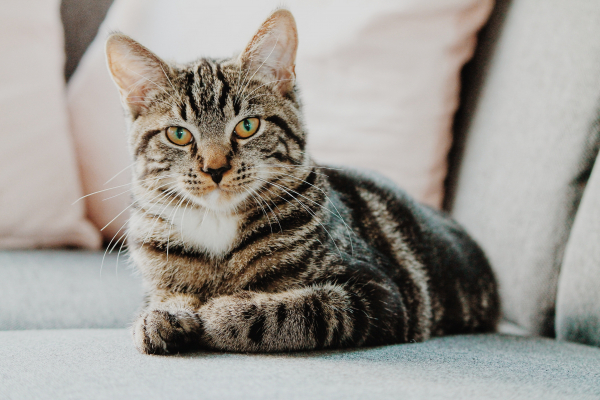
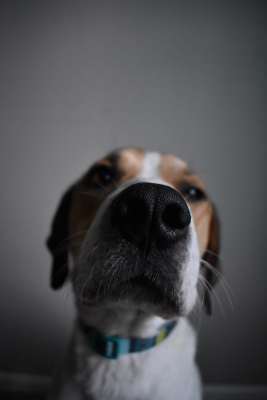
Kittens, as well as a number of other animal offspring, are born blind. Their eyes open around the tenth day of their life and only after another week, they are fully functional. Even though the sight in a cat belongs among the best-developed senses, cats are slightly short-sighted for their whole lives.
Kittens, as well as a number of other animal offspring, are born blind. Their eyes open around the tenth day of their life and only after another week, they are fully functional. Even though the sight in a cat belongs among the best-developed senses, cats are slightly short-sighted for their whole lives.
Cat’s sight has the greatest sharpness when observing at a distance of two to six meters. But what happens right in front of its nose, the cat recognises rather through smell or using its whiskers, same as in the first days after the birth, when it’s directly dependent on these senses. What causes that?
Cat has limited eye mobility to the sides comparing to humans and also a smaller field of view. While we have about 220 degrees, cats have 205 degrees. However, it can better focus even on the edges of the field of view, because its eye lens is more bent. It also compensates it by a greater degree of spatial vision, which is for it, as for a hunter of small rodents in uneasy terrain, a great advantage.
Cats can also see really well in the dark. How come? Their cornea is more convex, so it captures more light beams. The pupil dilates depending on the amount of light. The less there is, the larger the pupil gets. It can cover almost the entire iris and thereby it lets maximum amount of light in the eye. This again corresponds with the life rhythm of the cat. Since it often hunts at twilight or in the dark. Under direct light, we can hardly see the pupil. It pulls back into a thin strip to protect the sensitive retina.
This brings us to another difference. While people have their pupil round under every light, the cat’s pupil pulls back into an elliptical shape, a thin strip. This happens, because it is closed by two muscles from the sides.
Cat’s eye is unique since a cat, as the only animal, has one extra vascular layer behind the retina - the so-called tapetum lucidum. It is composed of layers of reflective cells, a kind of “mirror”. The beams that once pass through the retina, reflect from it on the second reflective layer and they stimulate the receptors again. You could say, that every beam of light is used twice. That’s why cats need only a minimum amount of light for seeing. This reflective layer is also responsible for the effect of shining cat eyes.
When it comes to the colour seeing of cats, we still don’t understand it completely. However, it is deemed, that cats don’t put too much weight on colours. For example, rather than by colour, the kittens choose toys depending on whether they’re moving, making a sound or because of higher temperature. So far, we’ve only found that cat eyes contain cones that react to blue, green and yellow colour, while cones for red are missing completely.
From humans, the cat differs by the fact, that its eye has also a third eyelid, a winking membrane. It is only a thin membrane that constantly moistens and cleans the eye. That’s why cats almost don’t have to blink. This applies to cats around the whole world. What distinguishes the fluffy guys between them is the shape of the eye and their colour. Particularly the eye colour, next to slight deviations from head anatomy, is one of the important characteristics of the individual breeds.
Whether you’re rearing a cat anywhere, the cat’s eyes are an incredible organ without any doubt, which surpasses human eyesight in many respects :).
Jestli hledáte malého přátelského psíka se spoustou energie a dobré nálady, jste na dobré stopě. A navíc po něm doma určitě nebudete mít podlahu plnou chlupů, vhodným parťákem je totiž i pro alergiky.
Jezdíme na výlety, na dovolené a někteří z nás i na psí soustředění a tábory. Jak řešit stravování psího chlupáče mimo domov? Pokud je vám sympatická myšlenka přirozené masové stravy, konzervy pro psy jsou skvělou alternativou ke granulím. A na cestách...
Lámete si hlavu, jak správně krmit psího chlupáče v zátěžovém řežimu? Už nemusíte. Řešení je nasnadě. Díky vysokému obsahu masa a všem potřebným vitamínům a minerálům může dobře posloužit masová konzerva. Ta je navíc vhodná i pro příznivce barfování.
Víte, co monoproteinové krmivo je? Z názvu je to vlastně jasné, mono-protein. Můžete si říct, že to je přece ale spíš nevýhoda, že krmivo obsahuje jen jeden protein. Není tomu tak. Hodí se pro zdravé psy i pro ty se zažívacími problémy.
Touto zákeřnou a hlavně celoživotní nemocí mohou trpět nejen lidé, ale i naši čtyřnozí mazlíčci. Vy, co máte doma kočičí parťáky, víte, jak jí předcházet, jak ji u chlupáče rozpoznat a jak mu podat první pomoc?
Běh nás udržuje v dobré fyzické i psychické kondici. Stejně tak naše psí mazlíčky. Jak se naučit běhat společně se psem? Při canicrossu, jak se běhu se psem také jinak říká, pomáhá pes svou silou běžci v běhu. Jaká je k tomu potřeba výbava a co byste...
To, že je Bohumil Hrabal úzce spjatý s Kerskem, je celkem známý fakt. Věděli jste ale, že byl obrovským milovníkem koček a dodnes tu, podle místních, najdete potomky Hrabalových koček?
Jak se zachovat v případě, že vašemu psovi během procházky něco stane? A jak mu poskytnout první pomoc? Co by mělo být základním minimem v psí lékárničce? Jak na drobná poranění, otravu nebo alergickou reakci? Svoje tipy vám prozradí v dalším díle...
Kočky hrají v životě mnohých z nás důležitou roli. Jsou nám rovnocennými společníky, utěšují nás, rozesmívají a sdílejí s námi i nejrůznější všední okamžiky. Už po tisíce let jsou nám společníky i pomocníky. Svůj svátek si tedy jistě zaslouží.
Toto vzácné plemeno se velmi podobá svým předkům - Shar-Pei. Jsou to vlastně jeho zmenšeniny s pár odchylkami v povaze. Ačkoli je jejich výchova složitější, jsou to výborní rodinní společníci.
Psí apetit nezná mezí. A tak není neobvyklé, že pes spořádá kus klacku, se kterým si ještě před chvíli hrál, nebo se prostě jen “pase” na louce během procházky. Někdy to mohou odnést i vaše domácí květiny. Jaké rostliny ale pro psa mohou být nebezpečné...