One dog isn’t enough for you and you’re looking for an excuse that will help you vindicate having a whole pack at home? One option is to become a musher - a dog sled racer. For adrenaline lovers, who’d love to ride through the landscape on a sled using sled dogs it’s an ideal dog sport :). What dogs are the most suitable for dog sled races?
One dog isn’t enough for you and you’re looking for an excuse that will help you vindicate having a whole pack at home? One option is to become a musher - a dog sled racer. For adrenaline lovers, who’d love to ride through the landscape on a sled using sled dogs it’s an ideal dog sport :). What dogs are the most suitable for dog sled races?
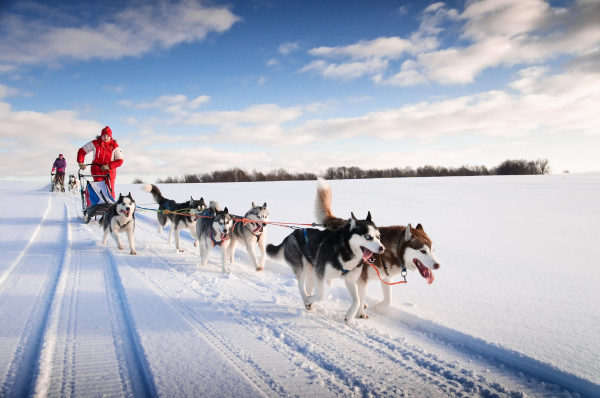
The answer is simpler, than you’d expect: all, who like to pull. From the logic of things, sled dogs are used most often. That’s why, in dog sleds, you’ll meet the Siberian Husky, the Alaskan Malamute, the Greenland Dog or the Samoyed, for example. There are also specially bred racing sled dogs. With them, it still depends on the discipline, in which the musher is competing. To put it very simple: for short to medium distances, dogs with a larger share of blood from a pointer are used and from the breeds that are similar to it, for longer distances fluffier, tougher dogs are used, like the Alaskan Huskies, for instance.
There are two main conditions of suitability: first, the dog has to like pulling and second, it mustn’t be aggressive towards others.
How difficult is the training?
A good racing dog has the desire to run and pull in them. If it needs to learn it, then something’s wrong. This doesn’t mean, that it can’t learn to pull, but it’s not as easy as the command “sit”. Every dog is simply suited for something else and it excels at what it likes. Force or strictness won’t do a thing.
What does a beginner have to do, so that it could start training?
The best way is to visit a couple of races or directly the mushers’ households and to find out as much as possible both about the given breed and its proper keeping and about the disciplines. It pays off to listen to more people and always prefer the ones, who have at least a season behind them, but also decent results. Long-term above-average performances are a proof of high quality of the dog, of care, stabling and, of course, of training as well.
Those who already have a dog and are attracted to dog sleds, should at first try, whether the dog will like it. Buy a made-to-measure harness and slowly begin to try it out. The teaching methods are various, for example, pulling chains or tyres. The most ideal way is a run with another dog. Since a more experienced dog can help your dog to understand a lot. You’ll surely find a partner for a training together in one of the money musher clubs. At first, it takes shorter and slower trainings and, most importantly, patience. And remember, that your dog must be happy during the training under any circumstances.
How do you train in months, when it’s not snowing?
The mushing season begins approximately in September and it ends roughly in March, April. So, it has the autumn and winter part. When there’s no snow, the trainings and races consist either of bikejoring (dog and a bike), scootering (scooter with one or two dogs) or canicross (running with the dog). The dog teams themselves then use a cart with small wheels instead of the sled. It’s usually home-made, but there are a couple of specialised producers. More safer motor quadricycles are also good for trainings of larger teams.
The races are governed particularly by temperature. In most cases, it applies, that races don’t take place, if the temperature is above 15 °C. The dog has no sweat gland and it could overheat. That’s why it’s necessary to adapt the training to the current temperature (to rather train early in the morning or late at night) and most importantly, to not forget to give proper amount of water to the dog before and after the training.
Where can you train?
Since there are not many trails that would be purely for training and maintained, intended only for dog teams, all the mushers train where they can. A trail prepared at least by a scooter always means a big plus. In individual disciplines, it’s much easier: they allow training on standard, maintained cross-country skiing trails. Although even here, there are certain rules: it’s better to go off-peak, to clean after the dogs, to respect the others “trail users”.
You might think, that this fun is a bit expensive, to buy all the necessary equipment, etc. But today, you have the option to just try mushing once, lessons are offered by professional mushers, who earn some extra money in their spare time this way.
Odmítání potravy se nevyhýbá ani zvířatům. Naopak, nechutenství je častým problémem, se kterým se majitelé psů setkávají. Pokud pes přestane přijímat běžnou krmnou dávku, může jít o dočasnou změnu nebo známku hlubšího problému.
Adopce mazlíčka je krok, který může změnit život vám i psovi či kočce, kteří v útulku čekají na svůj vysněný domov. A přestože adopce zvířete většinou přináší mnoho radosti, je dobré počítat s tím, že představuje specifické výzvy a často vyžaduje...
Stěhování patří mezi velmi stresující zážitky nejen pro nás, ale především pro naše kočičí společníky. Kočky jsou teritoriální zvířata, která milují rutinu a známé prostředí. Změna domova pro ně znamená ztrátu všech jistot – známých pachů, zvuků i...
Soužití dítěte a psa má mnoho benefitů a zvíře na dítě může mít velice dobrý vliv. Zároveň ale platí, že pes není hračka, a jejich vzájemný vztah vyžaduje vedení, jasná pravidla i vzájemný respekt. Přestože svou roli hraje i správná volba...
O kočkách lidé často uvažují jako o všežravcích, kteří mohou sníst opravdu cokoliv. Opak je bohužel pravdou. Kočky jsou nejen vybíravé, ale zároveň existuje celá řada potravin, které jsou pro ně nevhodné, nebo dokonce nebezpečné. Proto si vždy dobře...
Voda a léto patří k sobě – a mnoho psů miluje koupání a stejně jako jejich majitelé během horkých dní uvítají toto příjemné ochlazení. Ať už se chystáte k rybníku, řece, nebo moři, je důležité pamatovat na několik zásad, které zaručí, že bude koupání...
Otravy psů jsou bohužel poměrně časté a s příchodem léta a teplého počasí se riziko otravy ještě zvyšuje. Zkažené jídlo, mořská voda, sinice i jedovaté rostliny mohou ohrozit zdraví psa během chvilky. Díky znalosti prvních příznaků a včasnému zásahu...
To, že kočka není pes a má jiné nároky na výživu, už většina chovatelů ví. Přesto se dopouštějí drobných chyb, které mohou vést k nadváze, zažívacím potížím nebo nedostatku důležitých živin. Je proto dobré nezapomínat, že i kočičí stravování má svá...
Dovolená se psem může být skvělým zážitkem! Je ale dobré se na společné dobrodružství připravit. Každá změna prostředí a rutiny totiž může představovat pro zvíře větší či menší výzvu. Dovolenou je proto potřeba plánovat s ohledem na potřeby psa, aby...
Přestože kočky milují teplo a vyhřívání se na prosluněných místech, ani jim nemusí letní vedra dělat dobře. I kočkám totiž během tropických teplot hrozí přehřátí a dehydratace. V článku proto přinášíme tipy, jak kočkám v létě co nejvíce usnadnit...
Léto přináší nejen slunečné dny, ale i celou řadu rizik pro vašeho psa – od přehřátí a poranění tlapek až po skrytá nebezpečí během pobytu u vody. Abyste prožili léto bez starostí a zbytečných návštěv veterináře, je dobré myslet na bezpečnost. V...
Letní dovolené jsou pro nás časem odpočinku a vítané změny každodenní rutiny. Pro kočky může být ale váš odjezd na dovolenou stresující. Přestože jsou na rozdíl od psů více vázané na místo, ve kterém žijí, a obecně snášejí samotu o něco lépe, vaše...